You've Been Arguing About the SAVE Act. The Senate Still Calls It a Veterans Bill.
In February the House struck a veterans bill's entire text and inserted a new version of the SAVE Act. That rewrite, not the bill you've read about, is what's parked in the Senate. We checked every claim from both directions against the primary record.
Pro tip: in a rush, read the bold sentences. You will get the key insights.
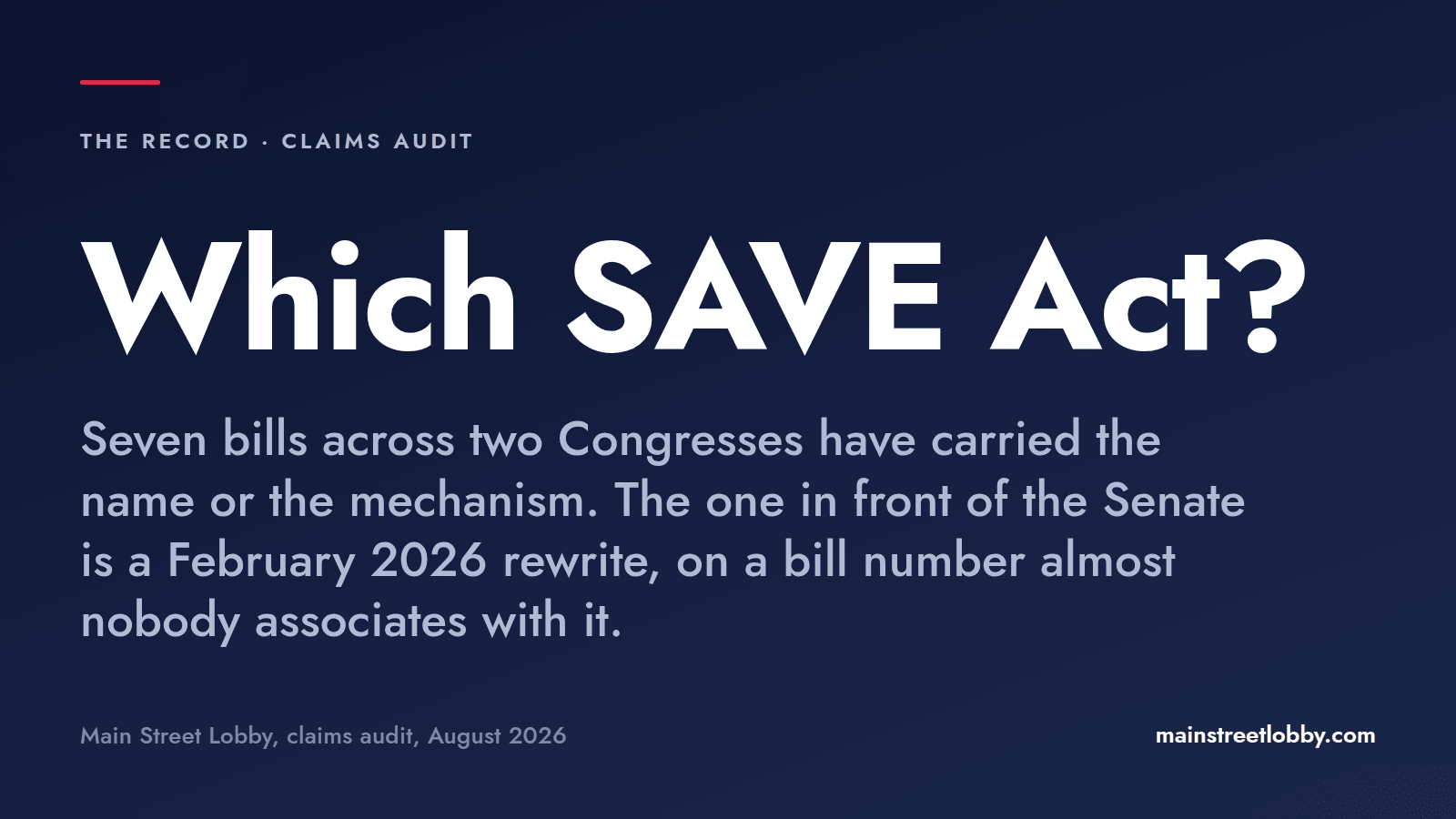
Which SAVE Act?
Seven dedicated bills across two Congresses have carried the SAVE Act's name or mechanism, two are dead, four of the five living ones are going nowhere, and the fifth, a February 2026 rewrite on a bill number almost nobody associates with it, is the one actually in front of the Senate.
Sometime in the last six months you probably had an opinion about the SAVE Act. Most people did. It is the rare piece of legislation that escaped the committee room and made it all the way into the group chat.
Here is an uncomfortable question: which SAVE Act?
That is not a trick. Seven dedicated bills across two Congresses have carried the name or the mechanism, and in July the House ordered the same text stapled onto two more moving bills, so even that count is out of date. Of the seven, two are dead. Five are technically alive, and they are not equally alive. Four of the five are going nowhere: one passed the House and has sat untouched in the Senate for sixteen months, and three never even left committee. The fifth is the one actually in front of the Senate right now, a February 2026 rewrite, carried on a bill number almost nobody associates with it, containing a provision the loudest critics say is missing and an entire section the loudest defenders never mention, because most of the argument on both sides was built against a version that is no longer in front of anyone.
Main Street Lobby agrees that only citizens should vote for elected offices. That isn't what this article is about. This article takes no side on the "bill". It takes a side on knowing which bill. With five dedicated bills alive at once and the same text now ordered onto two more, the honest response to most claims about the SAVE Act is not "that's not true." It's "which bill do you mean."
We read the four texts this fight has actually been about. We pulled the roll calls from the House Clerk and the Senate's own vote pages, the court findings from Kansas and Arizona, and the surveys both sides wave, from the survey sponsors themselves. Then we ran the loudest claims from each direction against those primary sources. Some claims survived contact. Some did not. Neither side's list of survivors is as long as its confidence. Shocking right?
Part one: seven bills, two stowaways, one survivor
In February 2026 the House struck the entire text of S. 1383, a Senate-passed veterans advisory committee bill, inserted the SAVE America Act, and passed it 218 to 213; the Senate voted 51 to 48 to take it up, and every 60-vote test since has failed.
The paper trail first, because everything else hangs on it.
In May 2024 a Texas Republican, Rep. Chip Roy, introduced H.R. 8281, the Safeguard American Voter Eligibility Act, with a Senate companion from Sen. Mike Lee. The House passed it that July, 221 to 198. The Senate placed it on its calendar and never took it up. On January 3, 2025, the 118th Congress ended and the bill died where it stood, because everything still pending dies when a Congress ends. Remember that rule. It is the clock under this entire story.
Next day, new Congress: the same text came back as H.R. 22. The House passed it on April 10, 2025, 220 to 208. The official status record lists what happened next in the Senate, in full: "Received in the Senate." That entry, dated April 10, 2025, is still the last one. If you searched the famous bill number this summer to see how the fight was going, that silence is what you found, and it is half the reason the feed lost the plot.
Because the fight had moved. In late January 2026, two fresh bills appeared carrying a new short title, the SAVE America Act, and a new second half: a photo identification requirement for voting, on top of the proof-of-citizenship requirement for registering. Twelve days after the House version of that pair was filed, its structure landed on a moving vehicle.
The vehicle was S. 1383. It was not an elections bill. It was introduced in April 2025 by Sen. Rick Scott as the Veterans Accessibility Advisory Committee Act, a short bill to create a veterans advisory committee. It went through hearings, cleared its committee, and passed the Senate with no senator objecting, on December 18, 2025. It was sitting at the House's desk when, on February 11, 2026, the House took it up under a rule with the swap built in: the rule declared that the new text "shall be considered as adopted," so approving the rule made the swap by itself, and there was never a stand-alone vote on the swap alone. Passage of the amended bill came separately, 218 to 213. The paperwork for that swap says so directly: "Strike out all after the enacting clause and insert:", legal language for deleting everything except the opening line and starting over.
What came back to the Senate was a three-part bill: a short title, the registration section, and the photo ID section. None of the veterans bill's actual provisions survived. What's left of it is just the shell: the bill number, the enacting clause, and the original title, still printed at the top of the paperwork.
Two things need saying at the same volume.
First: this is not a scandal. Strike-and-substitute is a standard legislative tool, used by majorities of both parties for decades. It is, structurally, how a chamber moves a priority when the front door is closed. Nobody hid it; the rule, the print, and the vote are all public. Even if it never hit your newsfeed.
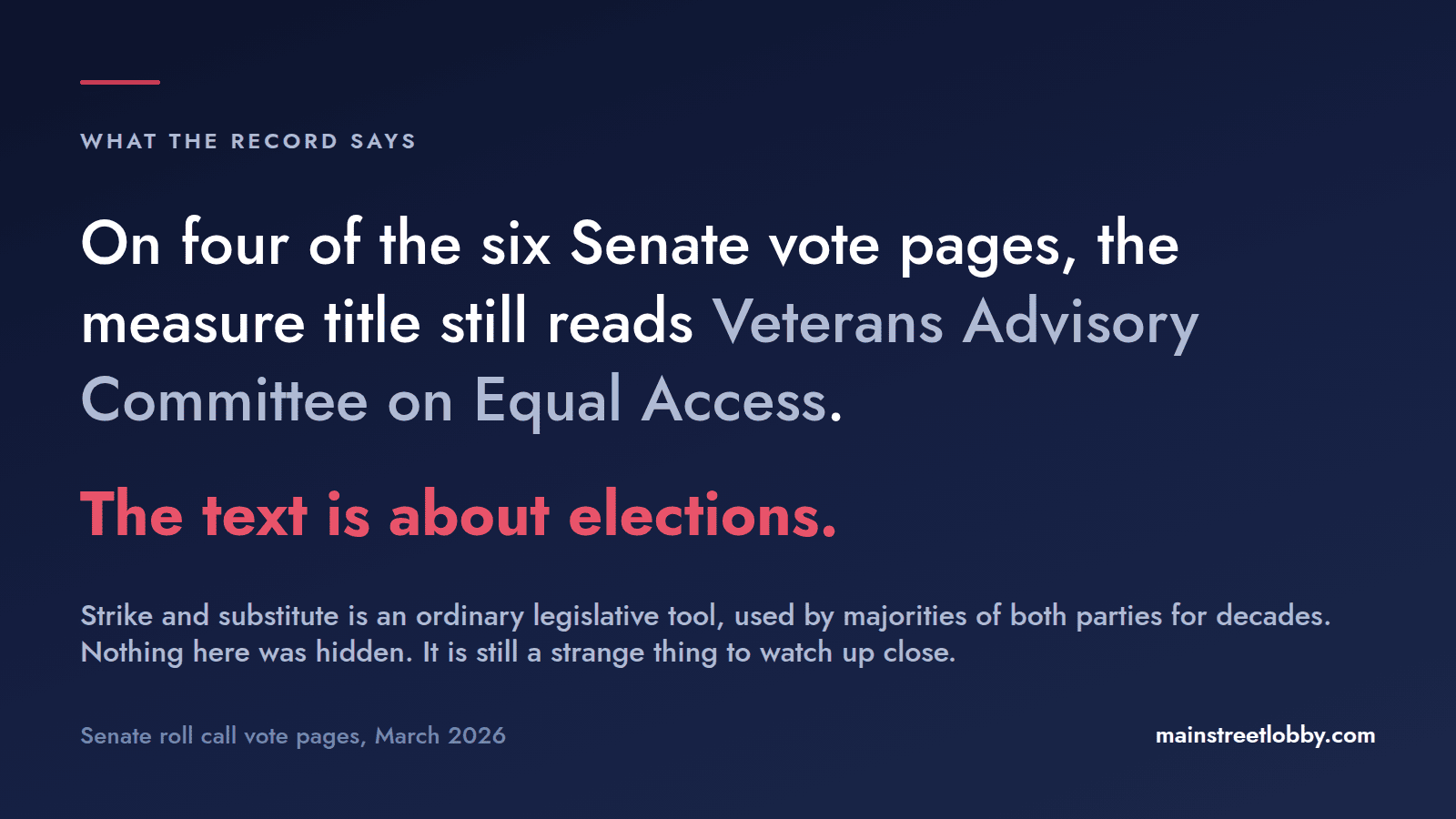
Second: it is still a strange thing to watch up close. The Senate's own vote pages from March 2026, four of the six of them, print the measure title "A bill to establish the Veterans Advisory Committee on Equal Access, and for other purposes" on votes that were entirely about elections. The record and the text describe two different subjects. That is a documentary fact about how the record reads, not a claim about anyone's conduct, and it is the other half of why the feed cannot find the bill.
What did that maneuver actually buy? An easier path onto the floor, not an easier path to passage, and the difference matters. A brand-new House bill has to be scheduled onto the Senate floor from scratch, which takes real effort. But because this text came back as an amendment to a bill the Senate had already agreed to work on (procedurally, a "message" from the House), the Senate could treat picking it up as a simpler, one-step question: a vote just to start debating it, called a motion to proceed, which needs only a simple majority of the senators voting. That vote happened on March 17, 2026, and passed 51 to 48. Actually finishing the bill is a separate and much harder question, and it pays to be exact about where the hard part sits. The final vote itself would take only a simple majority too. The wall stands one step before it: under the filibuster rule, getting to a final vote means ending debate first, and ending debate takes three fifths of the full Senate, normally 60 votes. That number never changed. While handling this measure the Senate has taken three 60-vote tests, two on amendments and one on a motion to suspend a standing rule, and all three failed. The motion to end debate on the bill itself has never even been filed. The House got through the easy door. The door that matters is still shut.
Part two: what the live text says, and what it said
The live text differs from the 2025 bill in ways both sides miss: an affidavit route for name changes, an entire photo-ID title, a new database check on existing registrants with safeguards attached, and an unresolved conflict between the official-penalty rule and the fallback route, all read from the printed text.
Nearly every viral claim about this legislation is a claim about the text. Seven dedicated bills have carried it, two more House-passed bills now carry it as an ordered attachment, and this piece audits four distinct versions: the 2024 House-passed bill, the 2025 bill as introduced, the 2025 House-passed bill, and the live 2026 rewrite. Here is the text, version-stamped, with the changes that matter.
The document list. All four versions use identical wording for the first item on the list of acceptable proof of citizenship: a REAL ID-compliant identification "that indicates the applicant is a citizen of the United States." That one clause matters more than anything else on the list, because the federal rule spelling out what a REAL ID card must show does not require it to display citizenship at all, and a separate federal rule allows states to issue REAL ID cards to legal noncitizens too (6 CFR 37.17 and 37.11). Whether any particular state's card actually shows citizenship, and for how many people, is an open question our record flags rather than answers. Both sides should want that answer before claiming the list is either easy or impossible to meet. A passport, for what it's worth, satisfies the requirement on its own, in every version.
The in-person rule. This is about registering for the first time, not about anyone already on the rolls; the rules for existing registrants are separate and come later. In every version, the proof itself must be presented in person: to the election official's office by the registration deadline, or, in states with election day registration, at the polling place. There is no mail route for the documents in any version. At the same time, no version prohibits mail registration, online registration, or registration drives; the mechanism is a condition on what a state may accept, not a ban on how forms travel. Both of those sentences are true. Each side quotes exactly one of them. So yes, you can register to vote by mail. It just isn't effective until you show up in person and prove citizenship, a distinction without a difference. Details matter.
The name-change clause, the loudest fight of 2025. Against H.R. 22 as passed, the objection that a voter whose legal name no longer matches her birth certificate could be turned away at the counter was aimed at a real problem: that bill's process for handling mismatched documents was vague, left up to each state, and never mentioned names specifically. The 2026 text rewrote that clause. S. 1383, the bill actually in front of the Senate, requires that a state "shall accept and process" the application if the applicant provides extra documentation, or an affidavit, a signed statement made under oath, establishing that the name on the document is a previous name. The old, vaguer language did not disappear; it survives, renumbered, one paragraph down. So the objection as made in 2025 was aimed at something real in that year's text, and the 2026 text answered it with this new affidavit option. What is still contested is whether that answer is good enough. The affidavit process runs through fifty different state systems that do not exist yet, with no standard form, fee, or notarization rule written down anywhere. The applicant still has to show up in person with documents that do not match her name, and she has to already know this remedy exists. Supporters get to say the bill fixed the problem. Opponents get to say a fix nobody has built yet is a promise, not a working process. Both of those are arguments about the real, current text, which is progress.
The section that did not exist in 2025. The live text has an entire second operative title no earlier version contained: photo identification to vote. It is routinely described as an in-person requirement. It is broader. For ballots cast "other than in person," the official may not accept the ballot unless the voter submits a copy of photo identification or the last four digits of a Social Security number with an affidavit of inability to obtain one. The exceptions are absent uniformed services voters and voters covered by a disability-access provision. Civilian overseas voters, a separate category in federal law, appear nowhere in the live text, in either title. If you have seen a take about the SAVE Act that never mentions a photo ID section, you have seen a take about the 2025 bill.
People already registered. One claim going around says everyone currently registered will have to re-prove citizenship just to keep their registration. No version of this bill says that. What the text actually does is narrower, and the details matter, because two different rules keep getting confused with each other, on both sides of the argument. The newest rule was added in the 2026 text: every state must run its entire list of registered voters through a federal citizenship-check database called SAVE, and if that check flags someone as a possible noncitizen, the state has to notify them and give them a chance to send in proof before removing them, with a Social Security record alone never being enough by itself. The rule from the older versions has been in every version since 2024 and works very differently: if a state gets information from any source that a registered voter is not a citizen, the state must remove that person, with no requirement to notify them first and no built-in chance to respond, in any version. The safeguards belong entirely to the newest rule, the database check, and the bill's critics rarely mention them. The rule from the older versions, the bare removal power, has none of those safeguards, though its defenders sometimes talk as if it did. And the database check itself is not yet running everywhere: the federal government reported agreements with at least 28 states as of this June, and in July two federal courts issued orders that contradict each other over whether the expanded system can keep running at all. Now the judicial branch is tangled up in this too: one court upheld a shutdown of the system, another ordered it restored, in the same summer. Nothing is clear.
Officials. Every version makes it a crime for an election official to register an applicant who did not present the required documents, punishable by up to five years in prison. But every version also includes a fallback: an applicant without those documents can still prove citizenship another way and get registered anyway. Read that again, slowly. Nobody has settled how those two rules fit together. If an official registers someone through the fallback, does that count as breaking the first rule, or is it a lawful exception to it? The bill's text does not say, in any version. That is a real, unresolved question, not a talking point for either side. This is exactly the kind of gap that ends up in court once a law like this is enforced. If the pattern above is any guide, expect the judges to disagree with each other too.
The housekeeping that tells you about drafting speed. The live text takes effect on enactment, applies to applications submitted on or after that date, gives states 30 days to stand up the list-maintenance program, gives the Election Assistance Commission 10 days to issue guidance, appropriates nothing, and at one point sets a deadline of "October 1, 2025," a date that had already passed when the text was engrossed in February 2026. Reported as printed. Who believes any government can stand up a nationwide citizenship-screening program in thirty days, or write binding guidance in ten? Name the historical precedent, we will wait patiently...
Part three: the scoreboard
Against primary sources, the supporter case holds on legal architecture and fails on scale, the opponent case holds on access numbers only when quoted precisely, and the Kansas and Arizona records give each side a different line from the same page.
We audited the load-bearing claims from each direction against primary sources, under one rubric. What follows is each side's strongest ground and its weakest, in turn, plus the evidence that belongs to neither side alone. It alternates because the results do.
The supporter case's strongest ground is legal architecture, and it holds completely. Federal registration runs on a sworn statement, signed under penalty of perjury, not on documents. The Supreme Court ruled in 2013, by a seven-to-two vote, that a state cannot add its own documentary requirement on top of the federal registration form. The Tenth Circuit ruled in 2014 that the federal elections commission has the right to say no if a state asks for one anyway. And in April 2025 a federal court blocked the White House from doing the same thing by executive order instead, writing that the Constitution puts election rules in the hands of Congress and the states, not the president. A supporter who says the front door runs through Congress is not spinning. That is what the courts have actually said, and it applies the same way to all four versions of the bill.
The supporter case's weakest ground is scale, and it does not hold. Occurrence is real: states that look, find records. Georgia's 2022 citizenship review is best quoted, not paraphrased, because the release is internally inconsistent: it says 1,634 registration attempts could not be verified as citizens through the federal SAVE database, says separately that "In total, 2,258 voter registration applications are currently in 'pending citizenship' status," and says "None of these individuals have cast ballots in Georgia elections." Texas reported 27 cancellations on confirmed noncitizenship in 2025, plus 61 for failure to respond, and a first full SAVE run of more than 18 million registrations that flagged 2,724 and referred 33. There are real prosecutions and real convictions. But every denominator on record is minute: Michigan reported 15 suspected noncitizen voters against more than 5.7 million ballots cast, a rate the state put at 0.00028 percent. Kansas litigated the question for years, and the appellate court found "at most, 67 noncitizens registered or attempted to register in Kansas" over 19 years, a broader count of attempts. The study most often cited for a national estimate is built on a survey subsample of just 339 people. From that small sample, it produced a huge range: somewhere between 38,000 and 2.8 million votes nationwide. Even the study's own lead author later said it should not be used to argue that noncitizens decide elections, and a follow-up review of the same data found zero confirmed votes among the noncitizen respondents the survey considered most reliable. What gets caught by accident is a floor, not a rate. Nobody has a rate.
The opponent case's strongest ground is the access numbers, and they hold precisely as long as they are quoted precisely. The survey behind "21 million" reached 2,386 citizens in the fall of 2023 and reported that 9.1 percent of voting-age citizens, about 21.3 million people, could not quickly find their proof documents, defined by the sponsor as documents they "could quickly find it if [they] had to show it tomorrow." A separate and much smaller finding in the same work: about 3.8 million reported lacking the documents entirely. "21 million can't prove citizenship" restates the wrong number. So does rounding it up. The precise finding is strong enough; the imprecise version is how a good number dies. The circulating figure of 69 million affected married women, for what it is worth, is a derivation with two approximation steps, not a measurement, and we treat it accordingly.
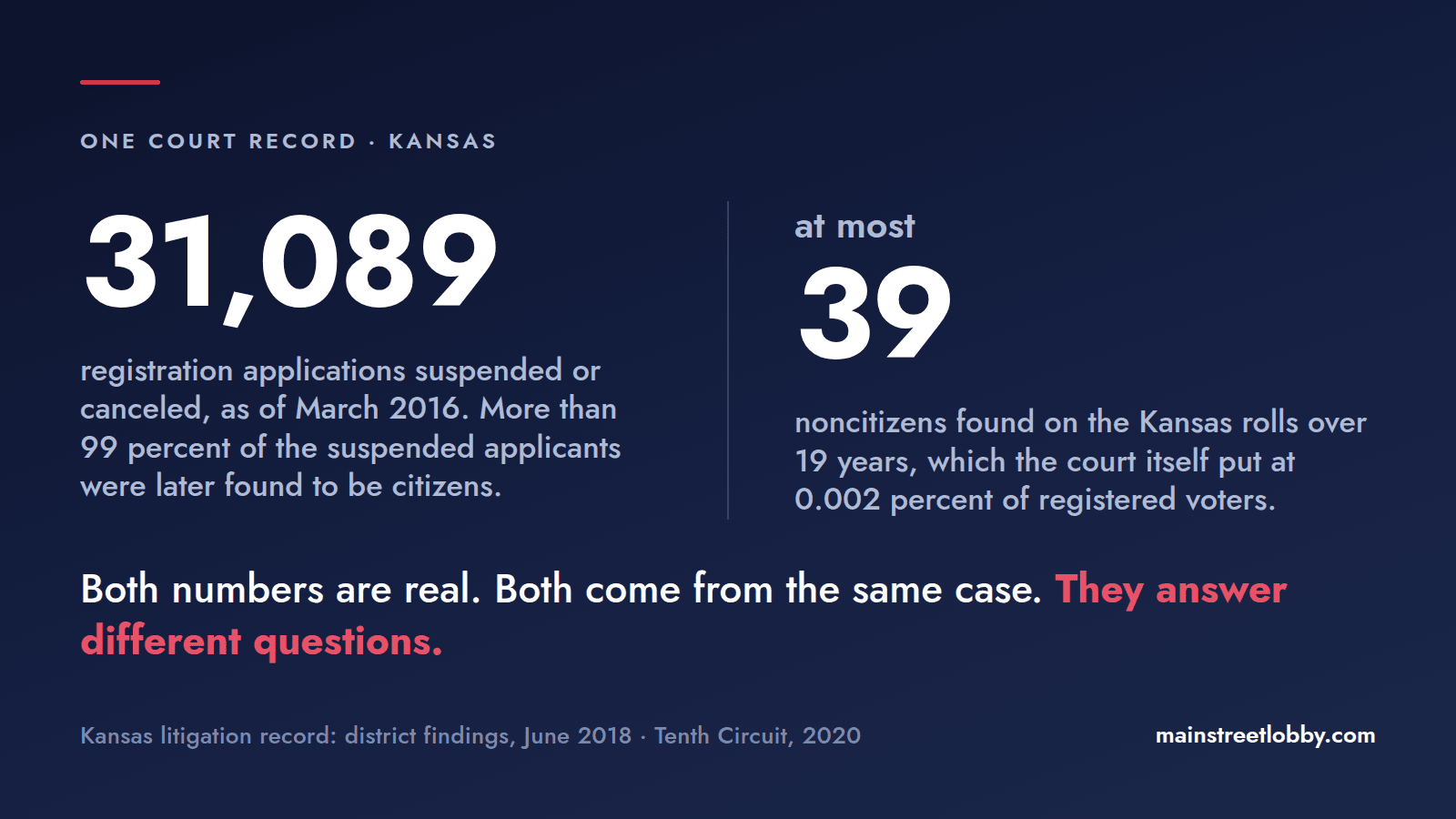
The Kansas record holds in full, for both sides, which is why each side quotes a different line of it. Kansas ran a documentary-proof regime from 2013 to 2016, and it is the only version of this policy ever tested in an adversarial trial. The same opinion, the same page, offers each side its number. Opponents lead with 31,089: registration applications suspended or canceled as of March 2016, 14,770 suspended and 16,319 canceled, more than 99 percent of the suspended applicants later found to be citizens. Their point: this law's cost fell overwhelmingly on people who had every right to register. Supporters lead with the court's other finding: "at most, 39 noncitizens have found their way onto the Kansas voter rolls" in 19 years, which the court itself calculated at 0.002 percent of all registered voters in the state. Their point is not that the number is large. It is that the number is not zero: over nineteen years of Kansas's own records, a small number of noncitizens still got through, which is exactly the vulnerability they say the law exists to close. One case. One page. Both numbers are real, and they are answers to different questions: how many were stopped, and how many got through. Which one you lead with says which question you think matters more. Lead with both. A federal court in New Hampshire added the newest data point on May 28, 2026, and it shows how narrow the 2013 ruling is. That case was about the federal form. New Hampshire does not use it: because the state has let people register at the polls on election day since 1994, Congress exempted it from the federal registration law, so it built its own proof-of-citizenship rule through its own machinery and the 2013 holding never reached it. That rule still stands. What the court struck down was separate. New Hampshire had also removed the sworn-affidavit backup that 14,737 voters, one registrant in ten, used in 2024. After a nine-day trial the court found seven women turned away in local elections because their citizenship documents carried a former name, and permanently blocked the removal. Its first page says the court is not deciding whether a state can require proof of citizenship, and that New Hampshire voters will still have to prove it. Whether a state can demand documents outside the federal form is therefore still unanswered. Two things follow. S. 1383 adds an affidavit route rather than removing one. It also strikes the exemption that keeps New Hampshire outside the federal system, so the one state where this has been tried in court is one the bill would pull in. One caveat we will state rather than paper over: this is a trial court's ruling from May, and we could not confirm from the public docket whether the state has appealed it.
Arizona is the live experiment, and it refuses to pick a team. Arizona registers applicants who do not supply documentary proof as "federal-only" voters instead of rejecting them. The state's own June 2026 table reports 43,894 federal-only registrants, and its own decomposition matters: 26,708 lacked proof of citizenship, 12,190 lacked proof of residency, 4,996 lacked both. The undecomposed total overstates the citizenship figure by roughly a third, and it circulates anyway. What happens to those registrants comes from the Ninth Circuit in February 2025, and it is not what either side usually says. Arizona tried to bar federal-only voters from voting for president and from voting by mail. The court held both bars preempted by federal law, and the Supreme Court had already declined to put them back in place. So these voters can vote in federal races, president included, and by mail. What they cannot vote in is state and local races. About 19,439 were active as of July 2023, under half a percent of the state's rolls. Nobody is struck from the rolls for want of documents, which is the supporter point. The registration they keep is still a partial one, which is the opponent point. An honest account carries both. One caution on all of it: the Supreme Court agreed on June 29, 2026 to hear Arizona's case, with briefing running into the fall, so this is the one part of the landscape with a scheduled expiration date.
The polling holds as a survey finding and fails as a slogan. Gallup's October 2024 item found 83 percent in favor of requiring proof of citizenship, with two limits printed on Gallup's own page: the question asked about first-time registrants only, and it left "proof of citizenship" undefined. The first limit matters most. The bill's own text never uses the words "first time"; it applies to anyone filing a new registration application, including someone re-registering after a move, not only true first-timers. To be fair in the other direction, it does not require proof from anyone who is already registered and files nothing new, with one exception: the live text's separate SAVE database check can flag an existing registrant as a possible noncitizen, and if that happens, the state must notify them and give them a chance to provide documentary proof of citizenship before removing them. That check, and its safeguards, are covered separately, in the section above on people already registered. Across published polls the number runs from 52 to 84 percent, tracking how the question is built, and the low end comes from the item that names the delivery mechanism. "Overwhelming support" is defensible for the abstract idea. Attaching one big number to this bill's actual text is not, because no located pollster has read the text to respondents.
Part four: dead, alive, and parked
As of August 8, 2026, exactly one thing moves under its own name, the House message on S. 1383, and its last recorded action was March 26; the 60-vote motion to end debate has never been filed, and everything still pending dies when this Congress ends.
Here is the ledger a reader can act on, as of this writing August 8, 2026.
Dead: the 2024 bills, which expired with the 118th Congress. Functionally inert: H.R. 22, received in the Senate in April 2025 and untouched since, plus three standalone reintroductions parked in committees. New in July: the House passed H.R. 8595, the State Department funding bill, 217 to 209 on July 15, and H.R. 8800, the annual defense bill, 216 to 212 on July 22, and the rule for each one directed the Clerk to add "the text of S. 1383, as passed by the House, as new matter at the end" on its way out the door. The orders are in the rules' text; we did not re-read the engrossed printings to watch the staple go in. Two more House-passed carriers now sit on the Senate side, behind the same 60-vote door as everything else. Moving under its own name: exactly one thing, the House message on S. 1383, which the Senate voted 51 to 48 to take up on March 17, 2026.
Then it stopped. The last recorded action of any kind is March 26, 2026. The step that would actually decide the bill's fate, the 60-vote motion to end debate on the bill itself rather than on side questions, has never been filed for, never been scheduled, and never been held. That is 135 days of stillness on the most argued-about bill in the country, while the argument about it has not taken a day off.
The same substance tried three more doors on other bills, and each attempt needed that same 60-vote threshold to survive a procedural challenge. In April, an amendment setting aside budget room for these requirements failed, 48 to 50. In June, two more amendments carrying the same registration-and-photo-ID language each failed too, 48 to 50 and then 50 to 49. We are inferring that these amendments matched the live bill from how they were labeled on the floor, not from comparing the actual text word for word; nobody, including us, has run that comparison, and the record says so plainly. The bill that hosted those June attempts, Public Law 119-98, passed anyway, without any of this in it.
What would actually have to happen for this to become law? Just the mechanics, no prediction. The Senate has to agree to the House's changes, and in practice that means one of two things: every senator agrees with no objection at all, which is not how this fight has gone so far, or 60 senators vote to end debate so the bill can move to a final vote, where a simple majority finishes it. So far, the most votes this substance has ever received on any 60-vote test is 53. The other path is that the House and Senate agree on identical text some other way before this Congress ends. Nobody knows exactly when that end date is yet. The Senate's own calendar lists December 18, 2026 as a target, the actual closing date has not been filled in, and the hard constitutional deadline is noon on January 3, 2027. Whenever it lands, everything still pending dies on that date, and this whole story starts over from page one, the same way it already did once, on January 3, 2025.
What eighteen months of this demonstrates
The fight and the bill have come fully apart: the fight runs every day at full volume over a text that is not in front of anyone, the bill has not moved since March, and nobody in the machine had to break a rule for that to happen.
Strip the issue content away and look at the machine, because the machine is the story here, and you will meet it again under some other bill's name.
A bill passes one chamber three times across two Congresses. The other chamber's calendar absorbs it without a sound. The text migrates to a vehicle that can reach the floor, clears the majority-vote step, and stops at the supermajority step, where it has now sat for over four months, unfiled and unscheduled, while its substance quietly fails three waiver votes on other vehicles and rides out of the House stapled to two more. None of this required a villain. Every actor in it followed the rules of the room.
Meanwhile the public fight over this bill, which is louder than the fight over almost anything Congress actually passed this year, is being conducted at full volume by people arguing about a text that is not in front of anyone, on both sides, with numbers that shrink or split when you open the source documents. The fight and the bill have come fully apart. The fight runs every day. The bill has not moved since March.
We are not going to tell you what to want here in regards to the "bill". A reasonable person can read the live text and want it to pass; a reasonable person can read it and want it to fail; both of them deserve to know which text it is, what it says, what the numbers underneath actually measure, and where the measure actually stands. That is what this article is. It is also, not incidentally, what a lobby is supposed to do for its members: read the record, all of it, and report back without a jersey on.
We will tell you what you should want in terms of your elected officials. You should want them to be detailed in the writing of bills. You should want them to put more effort into writing quality legislation than they do posting on social media. You should want them to be honest and not misleading when they publicly discuss legislation. Those are pretty low bars from our reading.
Washington is broken, but it is fixable. That is the subject of our next article to be published within the next week.
Main Street Lobby is built to hold politicians accountable to everyday Americans. Republicans, Democrats and independents welcome. Today you are not represented in the halls of congress. Join us in changing that, WE CAN'T DO IT WITHOUT YOU!
You tell us. We tell Washington. Join Today
Sources Every figure in this piece, grouped and dated. Tap to open.
Every figure in this piece was read against the document that produced it. The primaries are below, grouped and dated. Coverage was used only as a lead to a primary, never as the source of a fact.
Bill texts, Government Publishing Office
- S. 1383 as engrossed amendment, February 11, 2026, the live text. Read the text
- H.R. 22 as passed by the House, April 10, 2025. Read the text
- H.R. 8281 as passed by the House, July 10, 2024. Read the text
- S. 1383 as passed by the Senate, December 18, 2025, the host bill before the substitution. Read the text
Roll calls and procedure
- House roll calls, Office of the Clerk: 2024 Rolls 344 and 345, 2025 Rolls 101 and 102, 2026 Rolls 068 and 069. House roll calls
- Senate record votes 57, 60, 61, 67, 68 and 73 (March 2026) and 96, 144 and 151 (April to June 2026). Senate vote menu
- Cloture motions, 119th Congress. Cloture motions
- House Rules Committee posting for S. 1383, carrying the rule that made the substitution. Rules Committee
- Dates of Sessions of Congress, and the 2026 Senate legislative calendar. Dates of sessions
Courts
- Arizona v. Inter Tribal Council of Arizona, June 17, 2013. Opinion
- Kobach v. U.S. Election Assistance Commission, Tenth Circuit, November 7, 2014. Opinion
- Fish v. Kobach, D. Kan., findings of fact and conclusions of law, June 18, 2018, the source of the 31,089 figure. Opinion
- Fish v. Schwab, Tenth Circuit, April 29, 2020, the source of the "at most 39" finding. Opinion
- Mi Familia Vota v. Petersen, Ninth Circuit, February 25, 2025, on Arizona's federal-only registrants. Opinion
- LULAC v. Executive Office of the President, D.D.C., April 24, 2025. Opinion
- New Hampshire Youth Movement v. Scanlan and Coalition for Open Democracy v. Scanlan, D.N.H., May 28, 2026, read against the full 98 page docket PDF. Appellate posture not confirmed.
States
- Georgia Secretary of State citizenship audit, March 28, 2022, quoted verbatim because the release is internally inconsistent. Release
- Texas Secretary of State statutory cancellation reports, CY2024 and CY2025. Report
- Arizona Secretary of State, federal-only registrants as of June 22, 2026. Table
- Michigan Department of State, April 3, 2025.
Studies, surveys and statute
- Brennan Center, June 11, 2024, the ready-access survey behind the 21.3 million and 3.8 million findings, with its methodology, field dates and item wording. Methodology
- Richman, Chattha and Earnest, Electoral Studies 36 (2014), the 339 person subsample. Paper
- Ansolabehere, Luks and Schaffner, Electoral Studies 40 (2015), and the authors' own posting, the reanalysis of that data. Reanalysis
- Gallup, October 24, 2024, the 83 percent item, with its own printed limits. Poll
- 6 CFR 37.11 and 37.17, the REAL ID rules. 52 U.S.C. 20501 et seq., the registration statute. 18 U.S.C. 611 and 1015.
Some questions in this piece are open rather than answered, and the piece says so where they arise: what any given state prints on a REAL ID card, the exact text of three Senate amendments, and whether New Hampshire has appealed. If any figure here is wrong, write to contact@mainstreetlobby.com. Corrections run with a dated note stating what changed, and the address of this piece never changes.
We will never sell, rent or trade your information. Cancel anytime.