The Epstein Vote Was 427 to 1. Forcing the Vote Was the Hard Part.
Last November the House voted 427 to 1 to release the Epstein files. The hard part was getting the vote at all. The same tool that forced it is sitting 134 names short on the one issue nearly everyone agrees on. We checked the signers' portfolios to find out why.
Pro tip: in a rush, read the bold sentences. You will get the key insights.
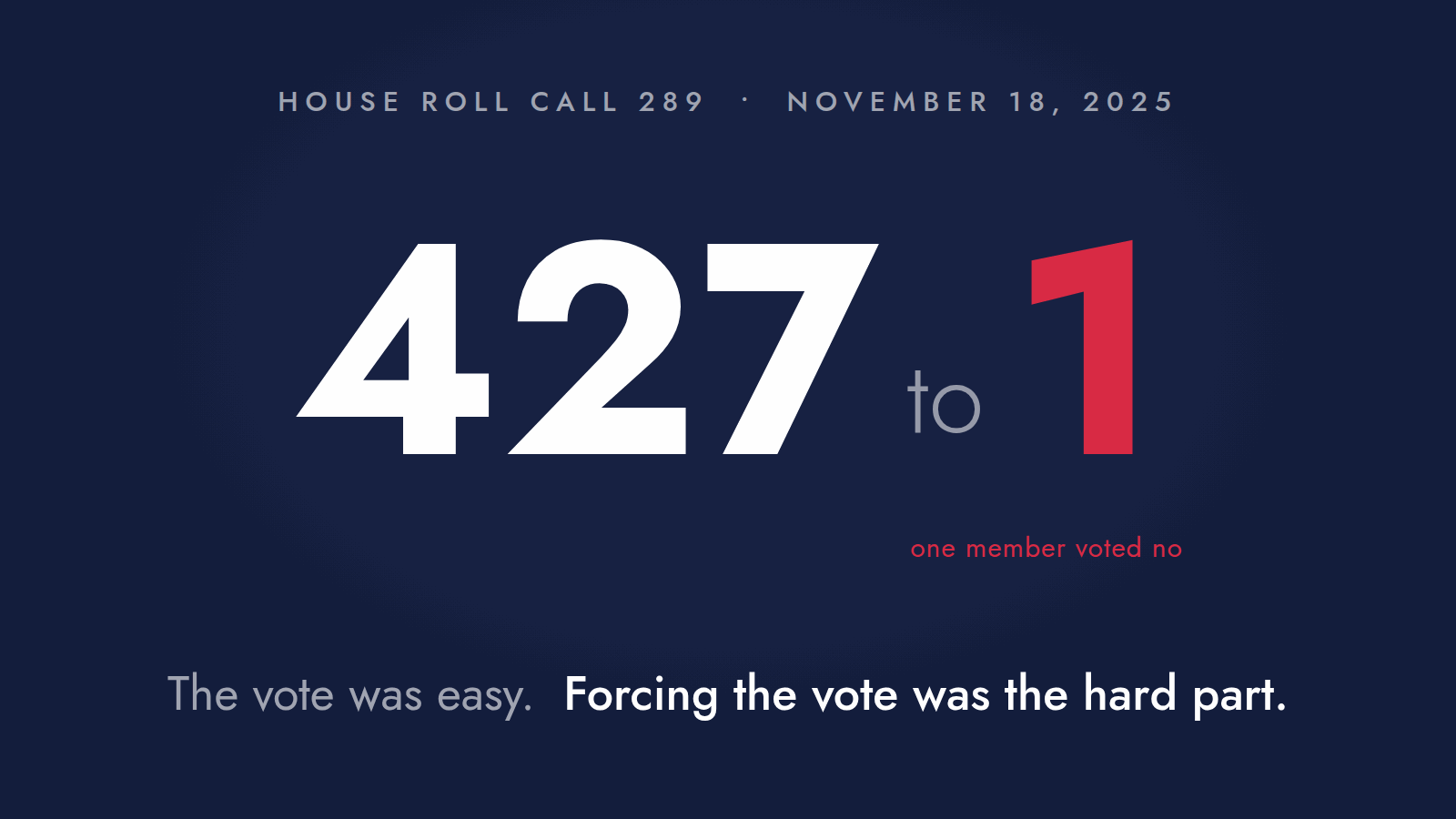
427 to 1
A bill nearly the whole House supported still needed 218 signatures on a discharge petition to get a vote, which makes this a story about who controls the calendar, not about Epstein.
Last November, the House of Representatives voted to release the Jeffrey Epstein files: 427 to 1.
One no vote. Out of 428.
That bill could not get scheduled. Leadership sat on it. It reached the floor only because a member filed a discharge petition in September 2025, and it took until November 12, when a newly sworn-in member added the 218th signature on her first day in office, to force it open. Six days later: 427 to 1. Law within the week.
A bill nearly the whole House supported needed 218 signatures on a piece of paper just to get a vote.
That is not a story about Epstein. It is a story about who controls the calendar.
The tool
A discharge petition is the only way to force a House floor vote without the Speaker's permission, and since 1993 every signature is public, so signing is a permanent, searchable break with your own leadership.
A discharge petition is the only way to force a House floor vote without the Speaker's permission. Once a bill has sat in committee 30 legislative days, any member can file one. Collect 218 signatures, a majority of the whole House, and after seven legislative days it can be called up on the second or fourth Monday of the month. Leadership cannot stop it.
The catch: since 1993 the signatures are public. Name and date, forever. Signing is a permanent, searchable break with your own leadership.
That's the price. That's the whole tool.
Twenty-six open right now
Twenty-six discharge petitions are pending in this Congress, several at or near 218, and one would ban members of Congress from trading stocks.
Tariffs. Ukraine. Health insurance subsidies. Veterans' retirement pay. Contraception. Honey labeling. Twenty-six petitions are pending in this Congress. Several already sit at 218. Several sit a handful of names short.
And one would ban members of Congress from trading stocks.
Stuck at 84
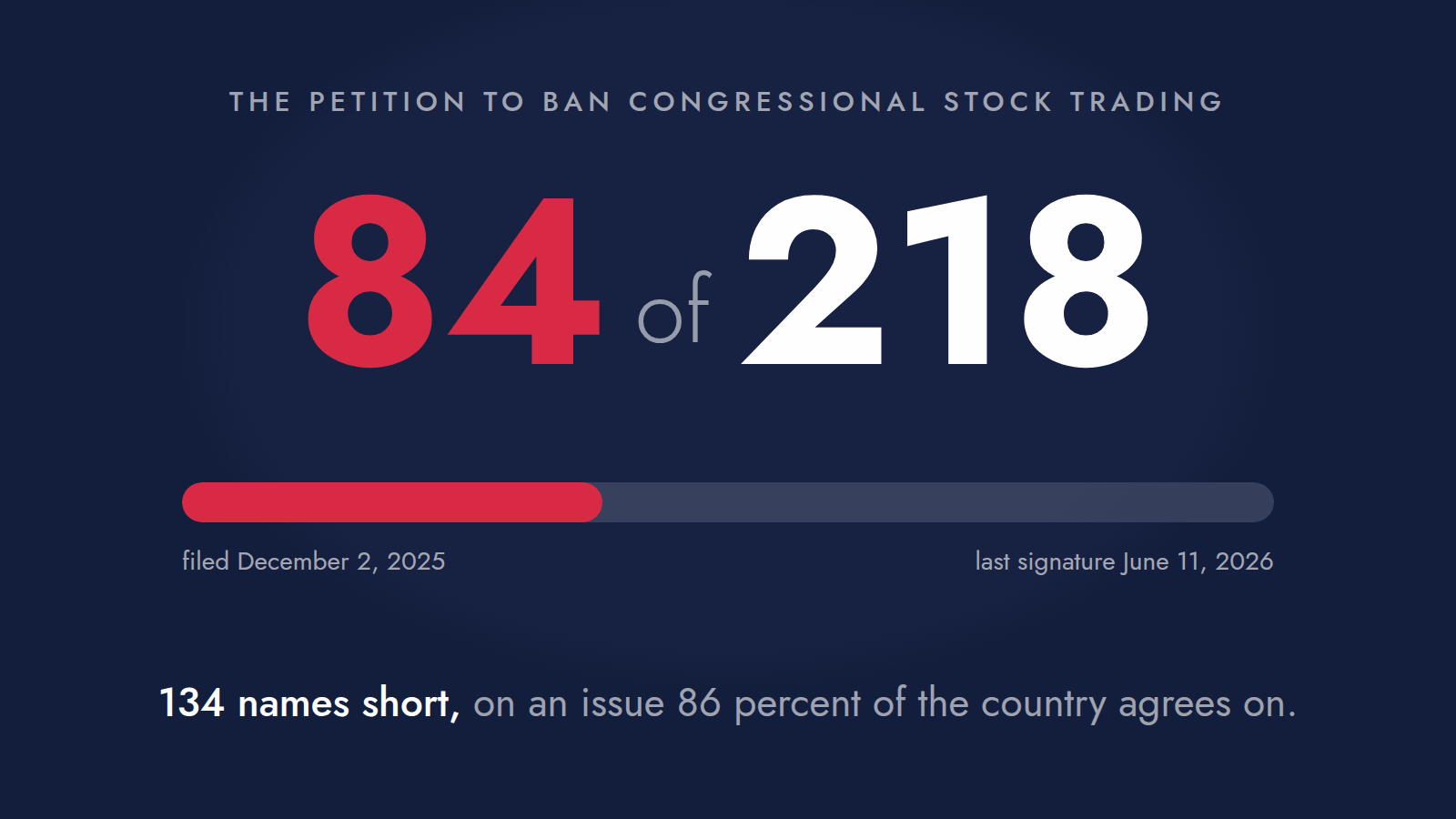
The stock-trading petition, filed December 2, 2025, on an issue with 86 percent support in a 2023 survey, sits at 84 of 218 signatures, and the last name went on June 11.
Filed December 2, 2025: prohibit stock trading and ownership by members of Congress, their spouses, and their dependent children.
Support: 86 percent, in a 2023 briefed survey. 87 percent of Republicans, 88 percent of Democrats, 81 percent of independents. A one point gap between the parties. Nothing in American politics is more agreed on.
Signatures: 84 of 218. The last name went on June 11, fifty-nine days ago. Seventy-four signatures came in the first sixteen days. Ten in the six months since.
So we checked the signers' portfolios
We ran all 84 signers against the House Clerk's disclosure record: seven in ten report no individual stock trading, the ten heaviest traders split five and five, and whatever is holding this at 84 has almost nothing to do with anybody's portfolio.
Both lists are public: the signature roster, and every member's stock disclosures. Nobody had put them side by side. We did: all 84, against the House Clerk's filing record.
Seven in ten signers report no individual stock trading at all. Index funds, retirement accounts, Treasuries. Some hold essentially nothing.
Eleven reported transactions dated after they signed. Those trades are legal; that is exactly what the bill would change. And most are not what they look like: a spouse's account, a trust the member does not direct, shares converted automatically in a merger. Strip those out and a handful of members signed the ban and kept trading. A rounding error in a 435 member chamber.
Then the surprise. If self-interest explained this petition, the heaviest traders would be the holdouts. They aren't. Of the ten most active stock traders in the House through December 2025, five signed and five didn't. The single highest volume trader in the chamber is a signer. A coin flip.
Signers trade at close to the ordinary House rate: about 21 percent show individual stock trading this Congress, versus roughly 32 percent chamber wide. Lower, but nowhere near what the hypocrisy story needs.
So the self-interest story collapses in both directions. The signers aren't unusually clean. The holdouts aren't unusually dirty. Whatever is holding this at 84 has almost nothing to do with anybody's portfolio.
Which leaves the boring answer, which is the correct one: signing costs you something with your leadership, and 134 members have decided that price is too high on an issue 86 percent of the country agrees on.
Meanwhile, the penalty for filing a late stock disclosure is a minimum fee of $200, waivable. Criminal prosecutions under that law since it took effect in 2012: zero.
It almost never works
From 1931 through 2002, 563 discharge petitions were filed and two became law, so the tool is designed to be hard, and it is sitting 134 names short on the one thing nearly everyone already agrees on.
From 1931 through 2002, 563 discharge petitions were filed. Forty-seven reached 218. Two became law.
Two. In seventy-one years.
That is the honest weight of this tool. It is designed to be hard, and it is used almost never. Not because of procedure, but because 218 people have to be willing to be seen doing it.
The last success was nine months ago. It happened in public, it turned on one new member's first day signature, and it ended 427 to 1.
The tool is not broken. It is just sitting there, 134 names short, on the one thing nearly everyone in the country already agrees on.
Main Street Lobby is built to give everyday Americans one organized voice in Washington, so the pressure on that calendar comes from outside it. Republicans, Democrats, and independents welcome.
You tell us. We tell Washington. Join Today
Sources Every figure in this piece, grouped and dated. Tap to open.
Every figure was read against the record that produced it, all read or verified August 9, 2026. Coverage was used only as a lead to a primary, never as the source of a number.
Procedure and history
- House Practice, Chapter 19, "Discharging Measures From Committees" (Government Publishing Office).
- CRS Report 97-856, The Discharge Rule in the House, April 17, 2003, the source of the 1931 to 2002 counts.
- Office of the Clerk, Discharge Petitions index and individual petition signature pages, read August 9, 2026.
The vote and the law
- Office of the Clerk, Roll Call 289, November 18, 2025, the 427 to 1 vote.
- Public Law 119-38.
Disclosures and enforcement
- Office of the Clerk, financial disclosure filing indexes and individual Periodic Transaction Reports, read against the full signer roster.
- House Committee on Ethics, 2026 Instruction Guide and Late Fee Waiver Form, the source of the $200 minimum fee.
- Campaign Legal Center, February 18, 2022, on the absence of criminal prosecutions under the 2012 disclosure law.
Trading data and polling
- Capitol Trades data as compiled by The Motley Fool, updated January 22, 2026, for the chamber-wide and top-trader counts.
- Program for Public Consultation, University of Maryland, briefed survey fielded May 19 to 30, 2023, n=2,625 registered voters, margin of error ±1.9, the source of the 86 percent figure and its party splits.
Main Street Lobby does not support or oppose any candidate or party. No individual member of Congress is named in this piece. Every figure comes from a government record or a dated published analysis, and every one is dated so it can be re-checked.
We will never sell, rent or trade your information. Cancel anytime.